The Real Cost of One Hour of Downtime
By Nexxis, Inc.
September 21, 2026
Ask a business owner what an hour of downtime costs them and you’ll usually get a shrug and a guess. “A lot.” “Depends on the day.”
That’s an honest answer, and it’s also the reason the problem never gets fixed. A vague cost loses every budget argument to a specific one. When the quote for better connectivity has a real number on it and the cost of doing nothing doesn’t, doing nothing wins by default.
So here’s how to put a number on it. It takes about ten minutes and a look at two figures you already have.
Ignore the numbers you’ll find online
Search this topic and you’ll hit figures in the thousands of dollars per minute. Those come from studies of large enterprises — data centers, manufacturing lines, trading systems, companies where a stopped process has an immediate meter running.
If you run a 50-person firm, that number is useless to you. It’s not your business, and quoting it to your own team costs you credibility the moment somebody does the math and sees it can’t be right.
Your real number is smaller. It’s also more persuasive, because you can defend it.
The four parts
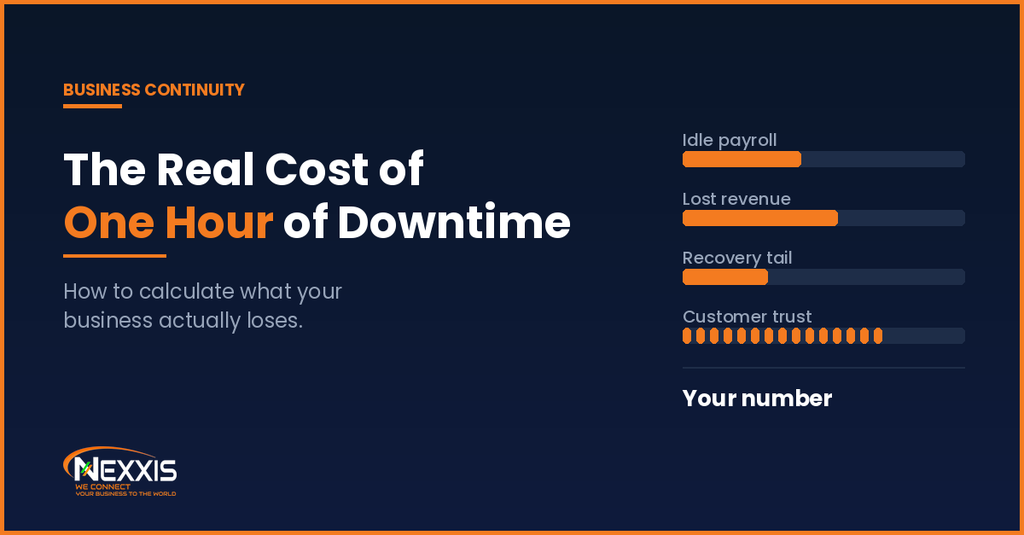
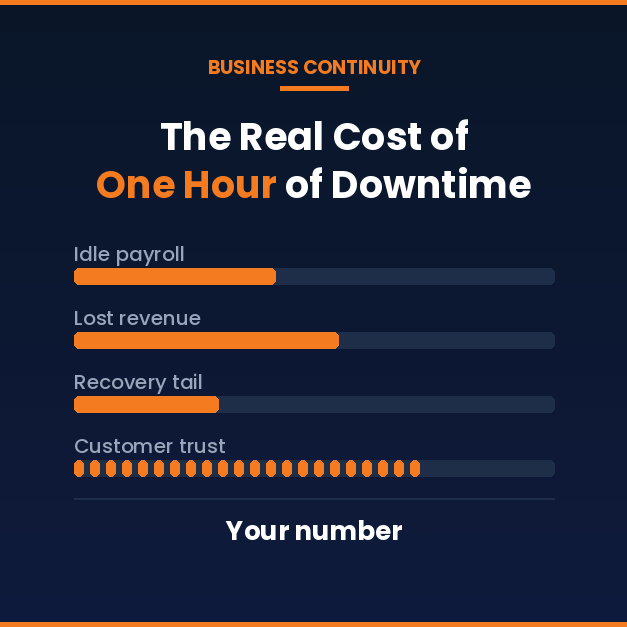
Downtime costs land in four buckets. The first two are easy to calculate. The third gets missed almost every time. The fourth can’t be calculated at all, and still matters.
1. Idle payroll
The wages you pay for work that can’t happen.
Take your annual payroll, including benefits and taxes. Divide by the number of people, then by 2,080 — the working hours in a year. That’s your loaded cost per person per hour.
Then multiply by the number of people actually stopped, not your whole headcount. In most outages some people can keep working on something. If two-thirds of your team is blocked, use two-thirds.
2. Lost or delayed revenue
Annual revenue divided by 2,080 gives you revenue per operating hour.
Now the important part: don’t count all of it. Some of that work simply happens later. A project deadline slips by an afternoon and nothing is truly lost. But some of it is gone for good — the call that went to voicemail and never called back, the transaction that didn’t complete, the walk-in who left.
Estimate what share is genuinely lost rather than delayed. For most service businesses it’s a fraction, not the whole thing. Being conservative here is what makes the final number hold up when someone challenges it.
3. The recovery tail
This is the one nearly everybody forgets, and it’s often larger than the outage itself.
When the connection comes back, you don’t return to normal productivity. You return to a backlog. Voicemails to work through, emails that piled up, half-finished work to pick back up, customers to call and apologize to, and an hour of everyone talking about what just happened.
A one-hour outage rarely costs one hour. Plan on the recovery period running at least as long as the outage, at reduced output. Some businesses see it stretch to double.
4. What it costs you with customers
There’s no formula for this one, so leave it out of the total and mention it separately.
A prospect who couldn’t reach you doesn’t file a complaint. They call somebody else, and you never learn it happened. A client whose meeting you dropped twice starts wondering how you handle their work. A patient who couldn’t get through to reschedule just doesn’t reschedule.
You can’t put a figure on it honestly. But it’s the cost that compounds, and it’s usually the one the owner cares about most once it’s named out loud.
A worked example
Here’s the math for a 50-person professional services firm. Use your own figures — these are only here to show the shape of the calculation.
Say the firm carries $4.2 million in annual loaded payroll and does $9 million in revenue.
- Loaded cost per person per hour: $4.2M ÷ 50 ÷ 2,080 = about $40
- Idle payroll for one hour, 70% of staff blocked: $40 × 35 people = roughly $1,400
- Revenue per operating hour: $9M ÷ 2,080 = about $4,330
- Share genuinely lost, not just delayed — say 40%: roughly $1,730
- Recovery tail, one extra hour at half output — (idle payroll + lost revenue) × 50%: roughly $1,565
One hour of downtime: around $4,700. Plus whatever it cost with the customers who couldn’t reach you.
That’s a defensible number. It’s far below the figures you’ll see quoted online, and that’s exactly why you can take it into a budget conversation without anyone rolling their eyes.
Now multiply it
This is where the exercise stops being academic.
One outage a year is an annoyance. But think about the last twelve months honestly — not just the total blackouts, but the mornings the connection was unusable, the afternoons of dropped calls, the hour somebody spent on hold with the carrier.
Four one-hour events in a year, at the number above, is roughly $18,800. That’s a real annual line item that appears nowhere in your budget, because nobody ever wrote it down.
Set it next to the annual cost of preventing it. That comparison is the entire point of the calculation, and it’s usually the moment the decision becomes obvious.
One more thing worth counting
Most owners only count the outages where everything went completely dark. But a connection doesn’t have to fail to cost you money — it only has to degrade. Calls that break up, cloud apps that crawl, video that freezes. Everyone works around it and nobody logs it as downtime, so it never enters the calculation at all.
We wrote about why that degradation is so easy to miss in why your Zoom calls freeze even when your internet speed test looks fine. If you’ve had more of those days than actual outages, your real annual cost is higher than the math above suggests.
What to do with the number
Once you have it, the question changes. It stops being “should we spend money on connectivity” and becomes “does the fix cost less than the problem.” That’s a question with an answer.
About Nexxis
Most downtime happens because a business depends on one connection from one carrier. Smart ConNEXion® Internet Access, a more intelligent, multi-path, multi-carrier solution, helps your business eliminate failures that can stop your day. Designed with FailSafe®, Same-IP Auto-Failover moves your traffic to a healthy path while keeping the same address so calls and other business application sessions stay online instead of dropping and reconnecting.
And because our Complete Voice & Data Solutions for Business puts your internet and your phones with one provider, an outage doesn’t result into two vendors pointing at each other while your team waits.
If you’ve run the numbers and want to know how to dramatically improve your uptime, we’re happy to take a look. Schedule a call or reach us at 1-888-7-NEXXIS.